The Czech labour market is entering another phase of transformation. It is no longer only about how many people companies can find. Increasingly, it is about how we organize work, how we develop people’s skills, and how we maintain work potential across generations..
The latest survey by the Labour Office of the Czech Republic among employers shows several important trends: employers continue to face a shortage of qualified workers, the importance of digital and technical skills is growing, and most companies do not yet see AI as a reason for mass layoffs, but rather as an impulse to change job content and required competencies. At the same time, the data show that part-time roles and flexible forms of work in Czechia are still more of an exception than a common standard.
And this is exactly where I see a major topic for career counselling, leadership, and HR.
According to the data in the MUMDOO chapter, 71% of organizations offer part-time roles, but part-time positions account for only 12% of the total number of jobs. In addition, 75% of these part-time roles are held by women. This means that while flexibility may look available on paper, in practice it is still not fully embedded in the way work is organized.
Globally, flexibility, lifelong learning, and skills development are no longer marginal topics. In its Future of Jobs Report 2025, the World Economic Forum highlights that by 2030, tens of millions of jobs will be both created and displaced, and that AI, data, technological literacy, creative thinking, resilience, and the ability to learn will be among the decisive factors. OECD also points out that employment and participation in OECD countries remain high, but labour markets are slowing down and the pressure to adapt is increasing.
From my perspective, this means one thing: career stability is no longer created by staying in the same role for an entire professional life. It is created by understanding change, naming one’s transferable skills, and actively working with one’s professional value. And this is where the work of a career coach comes in — a theme I increasingly encounter in coaching assignments.
What does this mean for employees?
Having a “good CV” is no longer enough. People need to be able to explain what value they bring,how they learn, how they work with technology, and how they can function in different work arrangements.
Age will also become a major topic. The Labour Office survey shows that people aged 55+ form a significant and stable part of the Czech labour market. They are not a “risk group”, but a strategic source of experience, stability, and know-how.To make sure this potential does not remain unused, we need to support reskilling, digital skills, flexible working arrangements, and age diversity.
What does this mean for employers?
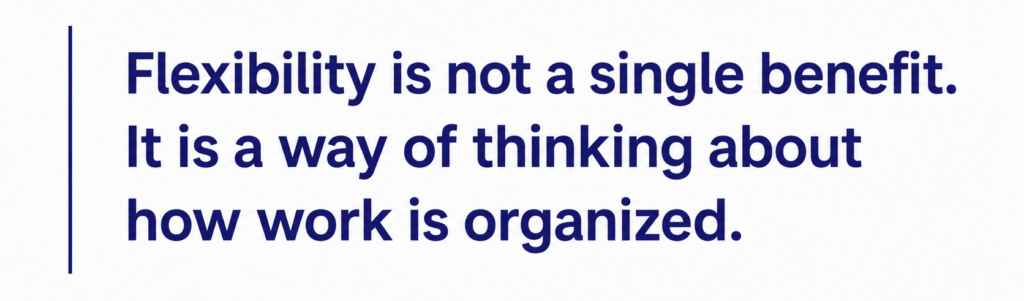
Flexibility cannot simply be one item on a list of benefits. It cannot mean only “occasional home office” or an exception for a few selected people.
Real flexibility means thinking differently about work itself:
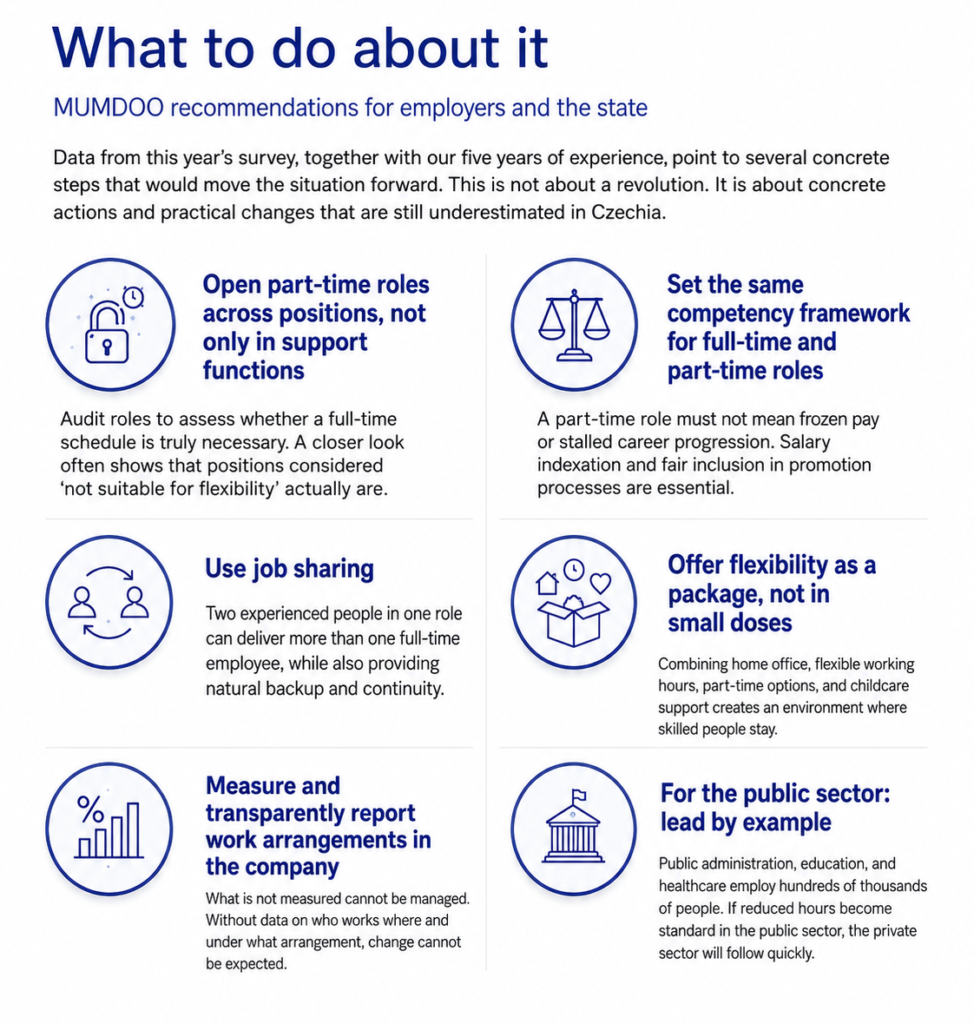
Which roles truly require a full-time schedule?
Where is job sharing possible?
How can career progression be set fairly for shorter working hours?
How can companies measure the structure of work arrangements?
And how can flexible time, place of work, working hours, and care support be combined?
This is exactly the direction of MUMDOO’s recommendations for employers and the state.
To develop flexibility and adaptability, I have also recorded a video course this year in cooperation with ICTPro, which will be released during the summer. The course will help participants develop both a growth mindset and physical flexibility in the body.
Resources:
Úřad práce ČR & MPSV: Predikce a realita pracovního trhu očima zaměstnavatelů 2026
World Economic Forum: The Future of Jobs Report 2025